
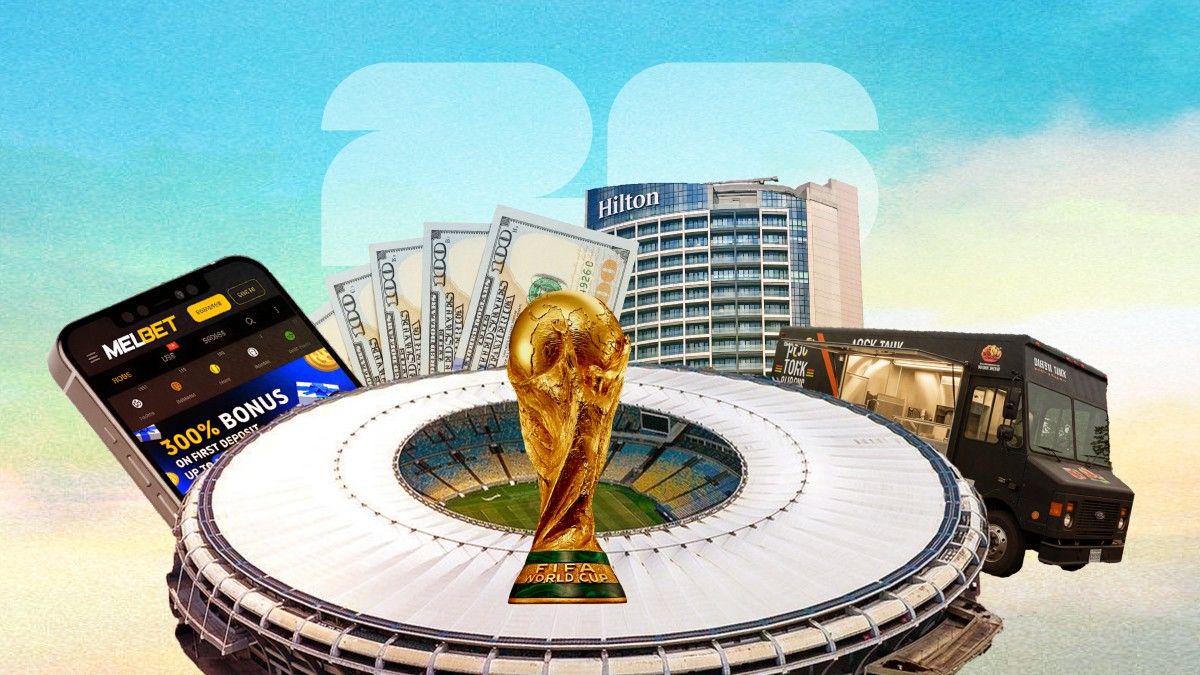
The FIFA World Cup 2026 is turning football into a 39-day business engine across Canada, Mexico, and the United States. 48 teams, 104 matches, 16 host cities. It is the largest tournament in the competition’s history by every measure that matters commercially: attendance, broadcast reach, matchday spend, and cross-border tourism.
Reuters reported that the tournament had already passed the 1994 World Cup attendance record by June 25, with the in-stadium count reaching 3,605,357 during Germany vs Ecuador in East Rutherford. That is the window.
For every business touching travel, hospitality, retail, media, payments, or betting, the next few weeks are the tournament in a business sense. Here is where the money is actually moving, and where the smaller opportunities sit.
Hotels Get the First Signal
Accommodation data shows where the first money moves.
Reuters reported that booked average daily rates for short-term rentals across host cities were $218, while last-minute travelers searching around June 8 were seeing roughly $335, according to AirDNA. That gap creates opportunities for property managers, cleaning crews, keyless-entry vendors, and local transport operators, not only hotel chains.
The risk is uneven demand. Oxford Economics has warned that the GDP and employment lift in US host cities will be moderate, concentrated in leisure and hospitality, and short-lived. Businesses that plan for a spike rather than a shift tend to do better after the trophy is lifted.
The Small Vendor Has a Shot
Large sponsors dominate the billboards. Smaller businesses can still win on timing and location.
A food truck near a fan zone in Dallas. A shuttle service outside New York/New Jersey Stadium. A licensed merchandise printer or local apparel shop in Toronto. The strongest local offers share four traits: fixed-price menus, fast mobile payments, multilingual signage, and pickup points that do not fight stadium security lines.
The trick is not to sell the tournament. It is to sell one match, one crowd, one hour before kickoff.
Betting Turns Match Attention Into Data
The betting sector is one of the clearest commercial winners because the expanded format adds inventory: more group matches, more live markets, more knockout paths.
Reuters reported that Macquarie forecast more than $50 billion in global wagers on the 2026 World Cup, compared with about $35 billion for Qatar 2022. That is a 43% jump in a single cycle.
For fans comparing operators or a betting site (Arabic: موقع مراهنات), the useful business layer sits in odds movement, live bet settlement, scorer markets, cash-out tools, and account verification, not banner noise. A France match with Kylian Mbappé changes goalscorer prices differently from a Brazil game shaped by Vinícius Júnior on the left. Operators that update markets cleanly during those 15-minute momentum swings hold attention longer.
The platforms that treat bankroll controls and clear market rules as retention tools rather than footnotes are the ones building customers who come back after the tournament ends.
Hospitality Sells the Premium Hour
FIFA’s official hospitality program, run through On Location, is built around ticket-inclusive packages: premium seating, food and beverage, entertainment, and stadium access.
That model creates business beyond the seat itself. Catering staff, event producers, security contractors, luxury transport, corporate client managers, and brand-experience agencies all touch the same matchday wallet.
A group buying a premium package for the final on July 19 is not only buying football. They are buying certainty around access, timing, and service. Corporate spending likes certainty, which is why hospitality margins in tournament football hold up even when general leisure spend softens.
Apps Compete for the Second Screen
The second-screen habit is now its own matchday market.
While the game plays on TV, fans check lineups, stats, standings, and odds on their phones. Companies are competing for those quick attention windows.
For anyone weighing a betting or fantasy app before a World Cup night, such as the MelBet download (Arabic: تحميل ميل بيت) or any similar option, the basics matter more than the marketing: quick login, reliable live odds, easy bet slips, clear cash-out options, account limits, and an app that does not crash when traffic spikes. The value shows when matches overlap and something like an early red card suddenly shifts totals, handicaps, and next-goal markets. For operators, the app is not just a tool to reach users. It is a large part of the whole experience.
The Real Money Is Uneven
The World Cup will open plenty of business opportunities, but the benefits will not spread evenly.
Cities like Houston, New York, and Dallas could see stronger gains in hospitality and leisure. Places that already attract heavy tourism might not feel as much of a bump. Mexico City and Toronto will see different patterns shaped by local spending habits and visitor flows.
The practical lesson for smaller companies is to sell around specific fixtures, not the whole tournament. Build the offer around one match, one crowd, one hour before kickoff, one service that saves people time. That is what turns a 39-day window into a business, and not just an event.
This article was written by an external partner and does not reflect the opinions of Monierate.com. Content is for informational purposes only and does not constitute financial or gambling advice. Sports betting carries real risk of financial loss. You must be of legal age in your jurisdiction to bet. If you or someone you know is struggling with gambling-related harm, contact a licensed support service in your country or speak to a qualified mental health professional.
